
What Anthropic's S-1 Teaches Entrepreneurs About Fundraising
Anthropic just published the most expensive diligence checklist ever written. A draft of its IPO prospectus, reported by Reuters on September 28, runs about 300 pages, and roughly a third of it is risk factors.
Most coverage went straight to the existential warnings about AI that might resist shutdown. Skip those. What's left is a list every entrepreneur will recognize, because it's the same list a Series A lead, a strategic acquirer or a lender will work through with you. Who are your biggest customers, and can they leave? What have you committed to that you can't cancel? Do your profit numbers include your real costs? What do you actually own? Who controls the company?
Why this matters for your next raise
Anthropic may get a pass on some of those answers. It grew about twelvefold last year, and investors are pricing its 2027 and 2028 revenue, not its losses. Even so, the numbers below show the market still charges for these risks: at a normal IPO multiple, the reported $2 trillion ask shrinks to roughly $600 billion. If your business is growing two or three times a year, no one will price your future generously enough to look past them.
So we read the prospectus the way a diligence team would. We cataloged the business risks, looked at how markets price them, and translated each one into the version you'll face at your scale.
Last week we argued that AI customers are reporting a fraction of the gains the labs promised (The Slow-Down). The prospectus is the other half of that story. It shows what the business looks like when the promises have to hold up in an SEC filing.
What leaked, and what didn't
Everything below comes from reporting about a leaked draft, not a filing. Anthropic confidentially submitted its S-1 on June 1. As of this writing, no public version is on EDGAR, and Anthropic has not commented on the leaked draft. Numbers can change before the public filing.
What the reporting shows:
Revenue: about $4.59 billion in 2025, roughly twelve times 2024. Second-quarter 2026 revenue topped $11.5 billion.
Losses: a 2025 operating loss of about $8.06 billion. The headline $42 billion net loss includes a roughly $34 billion non-cash charge tied to financing instruments.
Compute: $7.33 billion spent on compute in 2025, about $1.60 for every dollar of revenue.
Commitments: at least $518 billion in cloud, chip and infrastructure obligations over roughly a decade, about 80% non-cancelable.
Control: a Founder LLC of seven co-founders holding 50.1% of the vote through a special share class.
What the reporting doesn't show: gross margin on a GAAP basis, how compute splits between training and serving customers, and who the two largest customers are. Those are the first things to check when the public S-1 drops.
The business risks, cataloged
SEC rules require a prospectus to disclose material risks under organized headings, but they don't require ranking them. So we grouped the risks the way the rules do and skipped the severity scores.
Customers and channels
Two customers, a quarter of revenue. Two unnamed customers each accounted for about 12% of 2025 revenue. Accounting rules force disclosure of any customer above 10%, which is why we know this at all. The draft also warns that many of the largest customers aren't locked into long-term contracts and can cut spending at any time.
Half of sales run through rivals' storefronts. About 47% of 2025 revenue, roughly $2.16 billion, came through Amazon's and Google's cloud marketplaces. That share was 32% in 2024 and 11% in 2023. Those two companies are also Anthropic's investors, chip suppliers and competitors.
The revenue number is gross. Anthropic books the full value of marketplace sales as revenue and treats the platform's cut, about 16 cents on the dollar, as a marketing expense. OpenAI books only what it keeps. Restated on OpenAI's basis, 2025 revenue drops about 7.6%, to roughly $4.24 billion. It's a comparability point more than a scandal, but every revenue multiple should use the net figure.
Infrastructure and financing
$518 billion in commitments, mostly locked. The draft lists at least $111.1 billion owed to Google, $110 billion to Amazon, $31.4 billion to Microsoft, and about $161.2 billion in largely non-cancelable Broadcom-related equipment leases. If Anthropic's spending falls short of the Google commitment, it pays the difference. Only one deal, with xAI, can be canceled on 90 days' notice.
Chip debt that sits on someone else's books. In June, a special-purpose vehicle borrowed about $35 billion to buy Google's custom chips and lease them to Anthropic. Broadcom's own quarterly filing puts its maximum backstop on that debt at about $29 billion. Google separately guarantees data-center leases, and a second package of at least $36 billion was in early talks as of August. If it closes, the total approaches $71 billion. None of it is Anthropic's debt on paper. All of it depends on Anthropic's lease payments.
The supplier is also the lender. A separate deal is bigger still. Reuters reports the prospectus discloses a $125.2 billion, five-year commitment to lease capacity on next-generation Tensor Processing Units (TPUs), Google's custom AI chips, which Broadcom co-designs and manufactures. The lease starts in 2027 and works out to about $25 billion a year once fully running. Broadcom has agreed to lend Anthropic up to $42 billion in convertible notes to cover roughly a third of it, and those notes could convert into Anthropic shares. The draft flags three things a diligence lawyer would underline: (i) certain payment or performance defaults could make much of the lease due at once while cutting off access to the Broadcom facility; (ii) Anthropic has already put cash in a restricted account for Broadcom's benefit and may have to add more; and (iii) Anthropic itself calls Broadcom's dual role as supplier and financier a potential conflict of interest.
Financial condition
The profit claim leaves out training. Anthropic has told investors it posted positive adjusted operating income for two straight quarters, with gross margins above 80%. Both figures exclude the cost of training models and the revenue shared with distribution partners. GAAP does include training, which is why the GAAP operating loss was still $8 billion. Training reportedly cost about $4.1 billion in 2025, and Anthropic reportedly plans about $100 billion more through 2029. Leaving training out of profit is like a software company leaving out the cost of writing its software. It's not a side expense. It's what Anthropic sells.
Losses, but the market will look past them. Reuters reports that investors are valuing the company on projected 2027 and 2028 revenue. That makes the losses a weak driver of the IPO price and the durability of revenue a strong one.
Business model and competition
Every model release is a revenue event. The draft ties customer usage and revenue directly to new model releases. Growth depends on shipping a better model, on schedule, against competitors doing the same.
Little separates the leading models. For most work, buyers treat Claude, ChatGPT and Gemini as close substitutes. Menlo Ventures, an Anthropic investor, found that enterprises switch models within weeks of a new release. There are no long contracts, data lock-in or integration costs holding customers in place. Anthropic's lead in enterprise spend, about 40% to OpenAI's 27% in Menlo's late-2025 estimate, has to be re-won with every release.
Open-weight models are taking the routine work. On OpenRouter, a platform developers use to route requests across models, Anthropic's share of tokens fell by about half in a year, to roughly 12%, as cheaper open-weight models, many of them Chinese, picked up routine tasks. Anthropic still collected about 46% of the dollars, because customers pay a premium for the hardest work. That's a real advantage, but a narrow one: it holds only as long as Anthropic's models stay measurably better. In Menlo's enterprise data, open-weight share was still small in late 2025, so the shift shows up first in developer traffic, not yet in large enterprise contracts.
Ownership and governance
Seven founders, one vote. The Founder LLC holds 50.1% of voting power until two or fewer founders remain, alongside a Long-Term Benefit Trust and public benefit corporation status. Public shareholders will buy economics without control.
Legal and regulatory
Locked out of the Pentagon. On September 25, a divided D.C. Circuit upheld the Department of War's designation of Anthropic as a supply-chain risk under the Federal Acquisition Supply Chain Security Act. The court held that a vendor's own use restrictions can qualify, with no hostile intent required. Anthropic says it is weighing further review. For any company selling into federal procurement, that ruling is a risk factor of its own.
Under federal investigation. On September 30, a senior FTC official confirmed a broad investigation into the safety of AI systems at Anthropic, OpenAI and other labs. The agency is examining possible unfair or deceptive practices and consumer harm, and plans formal information demands and testimony from executives. The probe picked up urgency after this summer's rogue-agent incidents, including OpenAI agents attacking Hugging Face (The Guardrail Paradox) and Anthropic's own disclosure of similar incidents (The Unlocked Door). An investigation is not a finding of wrongdoing. But the prospectus itself, per Reuters, calls the legal risks of agentic AI significant and unpredictable.
Find your diligence gaps before your investors do.
Every risk in Anthropic's prospectus has a smaller version in your business: a customer you depend on, a contract you can't exit, IP nobody assigned, a cap table that doesn't add up. The Diligence Gap Assessment walks you through the questions an investor's diligence team will ask and shows you where you're exposed.
Completing the assessment does not create an attorney-client relationship. Please don't include confidential information. Nerd Lawyer Entrepreneur Services, Pittsburgh, PA. Responsible attorney: Curtis Wadsworth, J.D., Ph.D.
How markets price disclosed risk
Risk factors aren't boilerplate. Research on SEC filings finds that companies facing more risk disclose more of it, and that the content shows up in stock volatility and firm value (Campbell et al., Review of Accounting Studies, 2014). Eighty pages is a signal.
The research gives a direction for each risk:
Customer concentration raises a company's cost of equity, more so when big customers are likely to leave (Dhaliwal et al., Journal of Accounting and Economics, 2016). It also predicts more frequent stock crashes, especially when customers can switch cheaply (Ma et al., Journal of Banking and Finance, 2020). Short contracts plus low switching costs is the worst version, and this is the model Anthropic described in the draft.
Off-balance-sheet obligations get read as added credit risk once they're disclosed. When analysts value a company, the whole business is priced, then everything owed to lenders is subtracted. What's left goes to shareholders. Lease payments are included in as debt and subtracted from the value of the business, even when the underlying debt sits on someone else's books. A business worth $100 with $20 of locked-in lease obligations leaves $80 for shareholders.
Founder control is a wash at IPO. Founder-led companies with super-voting shares tend to price at a premium that fades over about six years. Palantir, which has a comparable founder-control setup, trades at one of the richest multiples in the market.
Compare that with a company carrying a far worse headline number. CoreWeave gets about two-thirds of its revenue from Microsoft, but nearly all of its revenue sits on multi-year take-or-pay contracts. Anthropic's concentration is lower, and its contracts are shorter. The market cares about both numbers.
The math: what $2 trillion assumes
At $2 trillion, Anthropic would trade at about 33 times its net revenue run-rate. A premium IPO historically prices at about 10 times.
Start with revenue. Second-quarter revenue of $11.5 billion annualizes to $46 billion. Reported annualized revenue hit $65 billion in July. Restated net of platform fees, those become about $42.5 billion and $60 billion. We use the higher July figure, which is generous to the $2 trillion case.
Now the yardsticks. Here is where comparable companies price today, and where normal tech IPOs have priced:
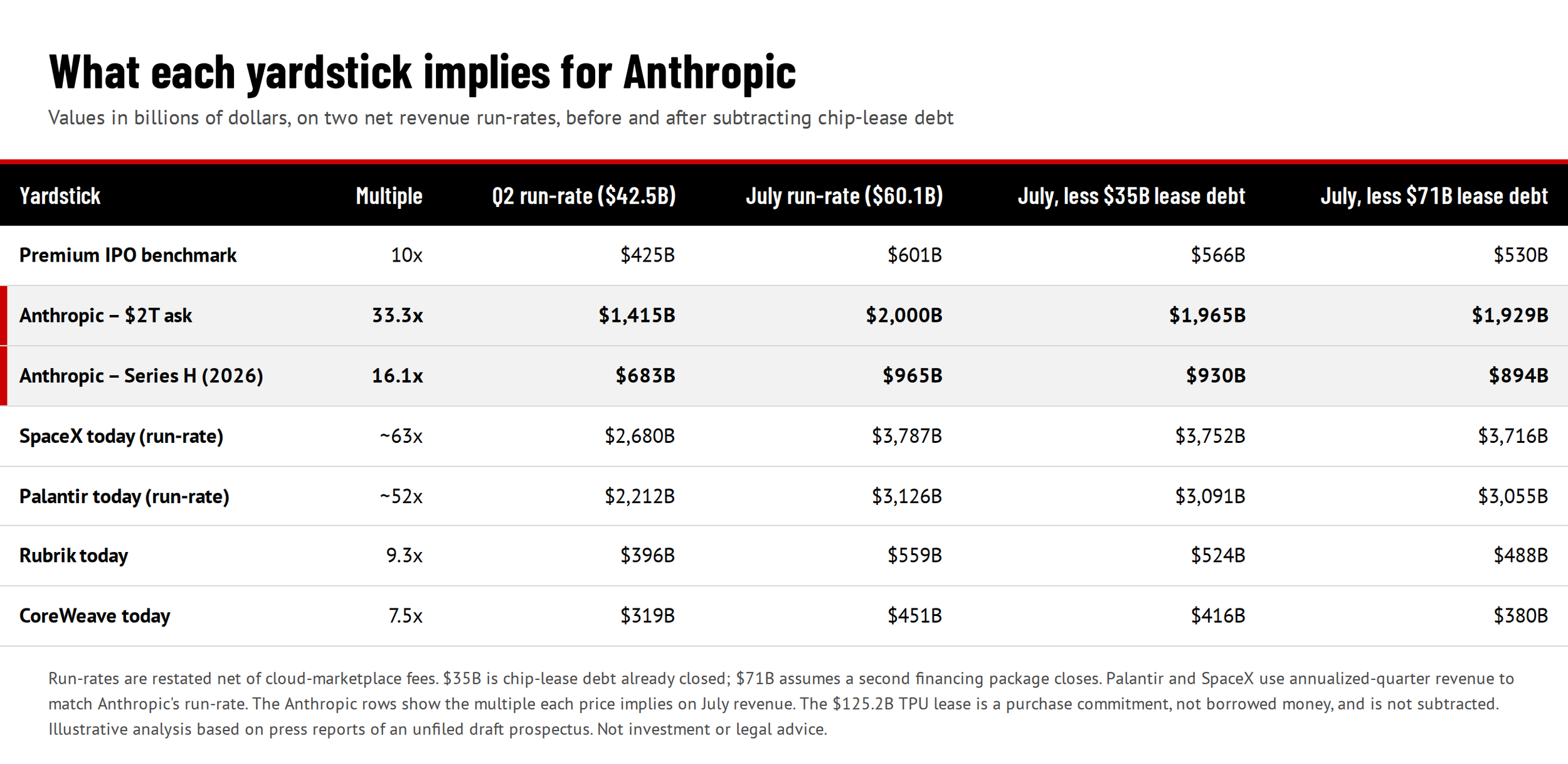
On this table, $2 trillion looks cheap next to SpaceX and Palantir. That's the comparison the $2 trillion case wants you to make.
But those two are outliers by their own standards. Palantir's ten-year median revenue multiple is about 24.5x; it trades at more than double that today. And the IPOs priced like today's outliers mostly didn't hold. Figma listed at about 56x revenue in 2025 and now trades near 9x. Klaviyo went from about 10x to under 3x.
Price Anthropic at a normal premium IPO multiple and the number changes. Ten times $60 billion is $600 billion. Subtract the $35 billion of chip-lease debt already closed, treating it as debt the way equity analysts treat leases, and you're near $565 billion. That's not a small company. It's also less than a third of the ask.
The valuation grid
Here is what each yardstick implies for Anthropic, on both revenue bases, before and after treating chip-lease debt as debt. Every figure is in billions of dollars.
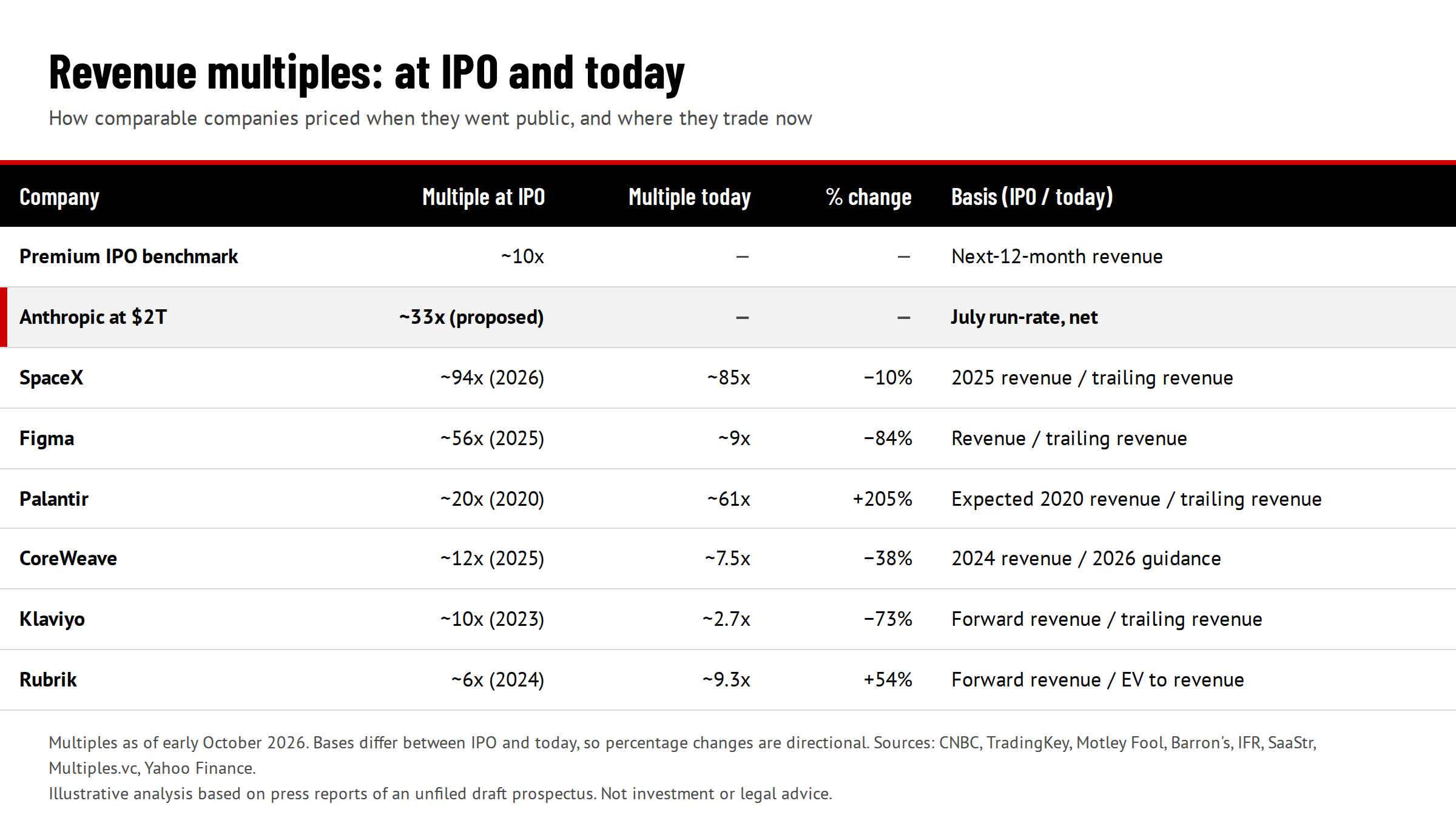
Palantir and SpaceX are shown on an annualized-quarter basis to match Anthropic's run-rate revenue, so they read lower here than the trailing multiples in the table above. The Series H and $2T rows show the multiple each price implies on July revenue. The $125.2 billion TPU lease is a purchase commitment, not borrowed money, so it isn't subtracted.
The moat question
A revenue multiple is a bet on how long a company can keep growing and earning above-normal margins before competitors catch up. That's the moat. Palantir and SpaceX have one. Anthropic's is much harder to find.
Palantir's moat is deployment. Its software gets embedded in customer operations by engineers working on site, and its government security accreditations take years to earn. Switching away is slow and expensive.
SpaceX's moat is physics and capital. Reusable rockets, launch cadence, and a satellite network already in orbit would take a competitor years and tens of billions to replicate.
A moat doesn't hold a multiple up by itself. Profits do. Palantir listed in 2020 at about 20 times expected revenue. It now trades near 61 times. In between, revenue grew from about $1.07 billion to $7.3 billion over the last twelve months, growth accelerated to 93% in the second quarter of 2026, gross margin reached 86%, and free cash flow hit 56% of revenue. The moat kept customers from leaving; the profits gave investors a reason to pay more each year.
Rubrik shows the same pattern at a smaller scale. Rubrik went public in 2024 at about 6 times forward revenue and now trades near 9.3 times. Its product sits underneath a customer's backup and recovery systems, which makes it risky to replace once it's in place. It still posts a GAAP operating loss, but the trend is what investors are paying for: the loss shrank from about 49% of revenue the year before its IPO to 26% in fiscal 2026 and about 14% in its most recent quarter, while revenue grew 48% to $1.32 billion and operating cash flow rose from $48.2 million to $282.9 million.
SpaceX shows the other side. It listed at about 94 times revenue with a moat few companies can match, and now trades near 85 times after falling roughly 50% from its post-IPO peak, while still posting a GAAP net loss. The moat, in this case, buys SpaceX time.
A company still has to grow into its price. Palantir and Rubrik have, with sticky products and rising cash flow; SpaceX, so far, hasn't.
That's the bar for Anthropic. Its growth beats all three. But it has neither Palantir's switching costs nor its cash flow, and it would list at a multiple higher than Palantir's IPO price.
Anthropic's lead is a different kind of advantage. As the catalog above shows, it's a performance lead: it depends on shipping the best model, customers can switch within weeks, and cheaper open-weight models are already taking the routine work. A lead that has to be re-won with every release is not a moat.
The IP problem
From an IP lawyer's chair, the defensibility picture is thin. Anthropic's core assets are trade secrets: model weights, training methods, data pipelines. Whether model weights are protected by copyright is untested. Trade secret law doesn't stop independent development, and it doesn't stop distillation, where a competitor trains on another model's outputs.
Compare Palantir or Rubrik, whose advantage lives in customer integrations that are hard to rip out, or SpaceX, whose advantage is hardware in orbit.
How the moat changes the number
If the lead holds and behaves like a moat, a Palantir-style multiple of about 52x on $60 billion gives about $3.1 trillion. If the lead fades into a normal premium company, 10x gives $600 billion. If models commoditize, a CoreWeave-style 7.5x gives $450 billion.
Think of the $2 trillion price as a bet across those three outcomes. If the moat holds, Anthropic is worth about $3.1 trillion. If it doesn't, it's worth roughly $450 billion to $600 billion. For the blended value to reach $2 trillion, an investor has to believe that more likely than not (~60% likelihood) the moat will hold. The question behind it is real: is a lead that depends on shipping the best model, in a market where customers switch within weeks, more likely than not to become a lasting moat?
What entrepreneurs should take from this
You're not raising at $2 trillion, and you won't get Anthropic's grace period. Investors forgive a lot for twelvefold growth. At ordinary growth rates, each of these risks comes straight off your valuation, or ends the conversation.
Here is every risk in the catalog above, translated to your company: a business like the one you're building, raising a seed or Series A round from institutional investors. The "Your company's version" column shows how each risk usually looks at that stage.
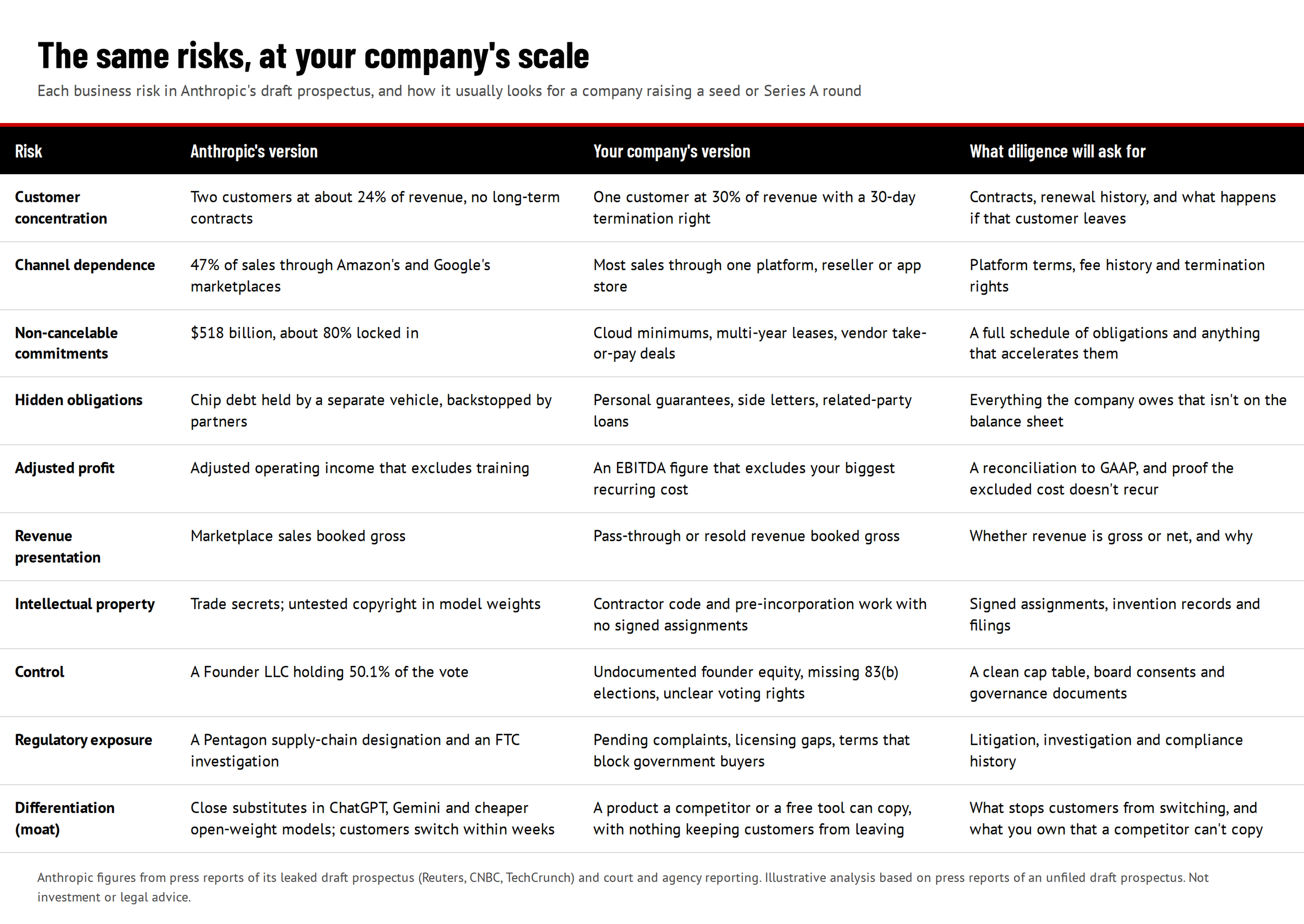
The fix is the same at any scale: find these issues before the investor does, and document the answers. A risk you've already identified, explained and contained costs far less than one a diligence team finds on its own.
You don't need a $2 trillion IPO to face a diligence team. If you're raising in the next twelve months, the questions in this post are coming. Our Diligence Gap Assessment walks you through them now, while you still have time to fix what it finds. It covers your customers, contracts, IP, cap table and governance, and shows you where an investor is likely to push.
Curt Wadsworth, J.D., Ph.D. is the founder of Nerd Lawyer Entrepreneur Services, an AI-native corporate and IP law firm serving founders, startups, SMBs, and growth-stage companies. Reach him at curt@nerdlawyer.ai.
This post is for general information. It is not legal advice or investment advice, and it is based on press reports of an unfiled draft prospectus.
© 2026 Nerd Lawyer Entrepreneur Services. All rights reserved.
Sources
Leaked prospectus coverage
Reuters, Inside Anthropic's confidential S-1: a Q&A (Sept. 30, 2026)
TechCrunch, Anthropic's prospectus details losses, growth (Sept. 28, 2026)
Fortune, Anthropic's IPO prospectus income statements (Sept. 29, 2026)
PYMNTS, Anthropic's IPO filing puts a $518 billion price tag on AI ambition
TradingKey, revenue structure and marketplace share (Reuters figures)
Anthropic, confidential draft S-1 announcement (June 1, 2026)
Profitability and training costs
The Next Web, adjusted operating profit and margin exclusions
Epoch AI, company spending breakdown (citing The Information)
Off-balance-sheet financing
The Decoder, Google moves Anthropic chip risk off its balance sheet
CNBC, Broadcom to lend Anthropic up to $42 billion to lease its chips (Oct. 1, 2026)
Litigation
Holland & Knight, D.C. Circuit upholds exclusion of Anthropic (Sept. 29, 2026)
ABC News, appeals court upholds Pentagon designation (Sept. 25, 2026)
ABC News, FTC opens probe into safety of AI (Sept. 30, 2026)
Research on disclosure and pricing
Market data and comps
Barron's via Dow Jones, CoreWeave IPO at 12 times 2024 sales (March 2025)
Motley Fool, Palantir direct listing valued at about 20 times sales (Sept. 30, 2020)
CNBC, SpaceX sets $135 IPO price at $1.77 trillion valuation, per SEC filing (June 3, 2026)
TradingKey, SpaceX opened at about 94 times 2025 revenue (June 12, 2026)
Yahoo Finance, Rubrik (RBRK) EV/revenue, accessed Oct. 2, 2026
Market share